Ideally, you should feed your dog more than 2.2 g of protein per kg of body weight daily, while their calorie needs per day are calculated as 70 × (body weight in kg)^0.75 × activity factor. But the calculations involved in figuring out how much food to feed your dog can be quite overwhelming, especially if you're a new pet parent. Don’t worry, it’s just about understanding the basics. After that, you'll be able to serve your furbaby balanced, filling, and wholesome meals in no time!
First things first, the amount of food that you should feed your dog for every meal depends on a number of things: weight, breed, age, physical activity, reproductive status, body condition, etc. Among these, the most important aspect is weight. When feeding a meal, we must consider their weight first, and the other aspects become tools to fine-tune a more custom diet for your pup.
The major components that you need to calculate for your dog's meals are protein and calories. Here's a basic chart that will help you decide how much protein and how many calories are needed for your dog:
| Weight Range (kg) | Calorie Range (kcal) | Protein Range (g) |
|---|---|---|
| 1 – 10 | 112 – 630 | 2.2 – 22 |
| 11 – 20 | 676 – 1059 | 24.2 – 44 |
| 21 – 30 | 1099 – 1436 | 46.2 – 66 |
| 31 – 40 | 1471 – 1781 | 68.2 – 88 |
| 41 – 50 | 1815 – 2106 | 90.2 – 110 |
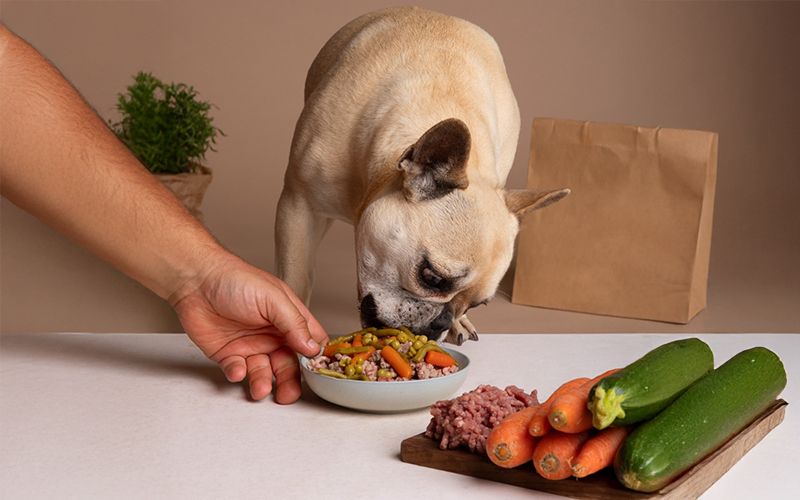
Fresh food brands like The Farmer's Dog, Ollie, Freshpet, BLEP pet food work well because they have high quality ingredients and come in meal-size packs, which makes feeding calculations easier. You can also add some boiled eggs, small amounts of boiled veggies, seeds, fruits, curd, or broth for some added healthy fats, vitamins, minerals, and hydration.
If you want a more custom diet chart for your dog, check out the BLEP Dog Diet Calculator.
What factors affect the daily feeding amount for dogs?
Let us now try to understand how certain factors in your dog's life contribute to how their meals may change:
- Weight: Dogs need about 2.2 g of protein per kg of body weight every day. Therefore, the protein requirement calculation formula is 2.2 × body weight. Calculating calorie requirements is slightly more difficult because the progression is not linear; the values change metabolically. The daily Maintenance Energy Requirement (MER), which is the number of calories needed by a dog per day to maintain a healthy body weight, including normal activity, is calculated as 70 × (body weight in kg)^0.75 × activity factor. For such calculations, usually, the activity factor is taken to be 1.6, based on a neutered adult dog.
- Age: Rule of thumb is, puppies need lots of protein & calories because they are in the rapid growth stage. Adult dogs need slightly less comparatively, because they only require those for body maintenance. Senior dogs, again, need slightly more protein because their muscle mass starts degenerating and slightly fewer calories because their activity levels drop.
- Breed: The size factor plays an important role in determining how much food should be given to a dog, and breed is a factor that provides further nuance to the calculation. For example, if an adult male German Shepherd weighs 20 kg, he is severely underweight. But if an adult male pug weighs 20 kg, he is massively overweight.
- Physical activity: A dog which is largely sedentary would require fewer calories and protein in a day than, say, a very active working dog. If too much food is given to the sedentary dog, in spite of their weight, there is still a risk of obesity. If too little food is given to an active dog, there is a risk of loss of muscle tone and malnourishment, no matter what their weight is. Therefore, the activity factor becomes so important. For obesity-prone dogs, it is 1.4, according to the Merck Veterinary Manual. For working/active dogs, this could go up to 2.0–5.0.
- Reproductive status: Pregnant or lactating dogs need more protein and calories per day than an average adult dog of the same weight. This is because they need to support both their own nutritional needs and those of their offspring. Spayed and neutered dogs need fewer calories than dogs who haven't been sterilised.
How much food should I feed my dog in a day?
Now, obviously, it is not possible to sit and measure every ingredient you're feeding your dog to ensure their meal is meeting the daily calorie and protein requirements. The best you can do is check the basic calorie and protein requirements of your dog (according to their weight) and then check your pet food label to determine how much you should feed your dog.
Let us take the example of BLEP Chicken Pumpkin Pawer dog food.
One 100 g pack of BLEP Chicken Pumpkin Pawer dog food contains 12.4 g of protein and 142.4 calories. Meeting the protein requirement from dog food is of paramount importance, because calories may be added in the form of eggs, rice, oats, quinoa, etc. So, based on protein requirements, the packs required for different weight groups are:
| Weight Range (kg) | Packs Needed/Day (100g) |
|---|---|
| 1 – 10 | 1 – 2 packs |
| 11 – 20 | 2 – 4 packs |
| 21 – 30 | 4 – 6 packs |
| 31 – 40 | 6 – 8 packs |
| 41 – 50 | 8 – 9 packs |
BLEP dog food 200g packs and BLEP dog food 300g packs are available for larger dogs, so here's the breakdown for those:
| Weight Range (kg) | Packs Needed/Day (200g) |
|---|---|
| 1 – 10 | 1 pack |
| 11 – 20 | 1 – 2 packs |
| 21 – 30 | 2 – 3 packs |
| 31 – 40 | 3 – 4 packs |
| 41 – 50 | 4 – 5 packs |
| Weight Range (kg) | Packs Needed/Day (300g) |
|---|---|
| 1 – 10 | 1 pack |
| 11 – 20 | 1 – 2 packs |
| 21 – 30 | 2 packs |
| 31 – 40 | 2 – 3 packs |
| 41 – 50 | 3 packs |
How many times in a day should I feed my dog?
All these charts may tell you how much food you should feed your dog in a day, but this must also be divided up depending on how many meals you feed your dog per day. Puppies are usually fed 3–4 small meals a day because it is easier on their stomach and they need a lot of energy. Adult and senior dogs may be fed about 2 meals a day. Here's a simple guideline you can follow:
- Large and extra-large breeds: Puppies (below 4 months): 3 meals/day. Adults and Seniors: 2–3 meals/day.
- Small and medium breeds: Puppies (below 4 months): 3 meals/day. Adults and Seniors: 2 meals/day.
- Toy breeds: Puppies (below 4 months): 4–5 meals/day. Puppies (4–6 months): 3 meals/day. Adults and Seniors: 2 meals/day.
What should I keep in mind while feeding my dog?
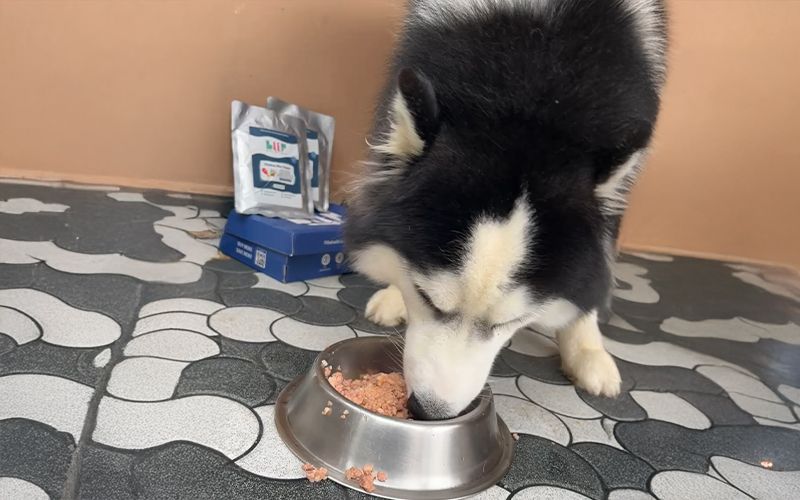
Dogs have a delicate digestive system, so you must take some extra care while feeding them. Here are a few handy tips:
- Introduce new food gradually: Sudden changes in diet may cause tummy issues in dogs. So, when introducing any new food, start by mixing small amounts of the food with the current diet for the first 2–3 days. Then, slowly start increasing the amount of new food and decreasing the amount of current food over the next 4–5 days. In about 9–10 days, your dog should be able to fully adapt to the new food.
- Do not overfeed: There will be times when your pup will beg for more food, either during feeding time or when the rest of the family is eating. It is very important that you stick to their meal plan and not give out extra meals. Be especially careful about treats. Treats shouldn't make up more than 10% of your dog's meal. Opt for natural treats without sugar, like BLEP Chicken Jerky Treats, or you can even give pieces of fruits and veggies as treats.
- Set a routine: When feeding your dog, it is best to set a routine. Have fixed meal times so that the food is digested better and your dog also knows when they'll be fed. This is especially important for rescue dogs, as they tend to overeat when they get food due to starvation anxiety. Routines also give dogs a sense of safety and comfort.
- Keep fresh water ready: Dogs must always have a source of clean water near their meal spot. This encourages them to drink more water and stay hydrated, especially in the summer and winter.
- Make adjustments according to season: You can add or take away small things from the meals depending on the season. During summer, add some curd to the food. It is good for the gut and helps keep dogs hydrated. In the winter, you can add some bone broth to the food for an extra shot of collagen and immunity. Open Farm bone broths and BLEP bone broths are slow-cooked and contain zero preservatives.
Frequently Asked Questions
How much food should I feed my dog by weight?
The two most important parts of a dog's diet are protein and calories. The basic formula for protein is that dogs need about 2.2 times their weight in protein per day. For calories, the calculation is a little bit more complicated: daily Maintenance Energy Requirement (MER) = 70 × (body weight in kg)^0.75 × activity factor. Usually, the activity factor is taken to be 1.6, based on a neutered adult dog. But if you're unsure, you can check out the BLEP Dog Diet Calculator.
How many times should I feed my dog per day?
The number of times you should feed your dog depends on the age and size of the dog. The rule of thumb is puppies may be fed 3-4 small meals a day, and adult and senior dogs may be fed 2 meals a day.
Should I feed my dog more if they are active?
Yes, if your dog is more active, they need stronger muscles, better healing capabilities, and more energy. Therefore, their nutrient requirements are higher than those of sedentary dogs.
Can I mix home food with packaged dog food?
Yes, absolutely! Home-cooked food is great for pets; it's just difficult to properly balance it. You can add natural, zero-preservative, human-grade dog food like BLEP with homemade boiled eggs, veggies, rice, oats, quinoa, etc. and turn it into a hearty meal.
How do I know if I am overfeeding my dog?
Overfeeding your dog can lead to a bunch of issues, including obesity. Here's how you can prevent accidental overfeeding. First, find out how much food you should be feeding your dog. A handy tool like BLEP Dog Diet Calculator will help. Next, get yourself dog food that comes in meal-size packets. This gives you additional guidance. Lastly, it is more likely that you end up overfeeding treats rather than meals. Choose natural, low-calorie treats like BLEP Chicken Jerky Treats and make sure that treats make up no more than 10% of your dog's daily meal.